Master of Professional Communication research|4 months
IT’S THE COLOUR OF MY SKIN:
RACE AND BEAUTY DISCOURSE WITH FENTY BEAUTY CAPTIONS AND USER COMMENTS ON INSTAGRAM
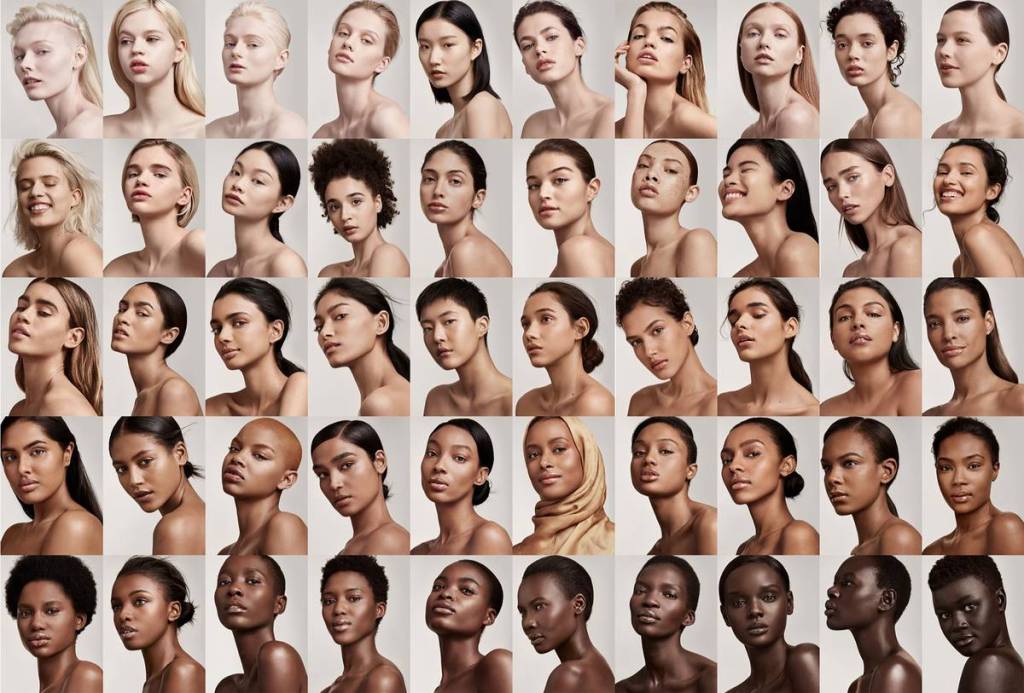
In 2017, TIME Magazine recognized Fenty Beauty in its list of “The 25 Best Inventions of the Year” for creating a comprehensive spectrum of complexion products formulated for 40 distinct skin tones (now at 50 shades). Following the brand’s launch, other makeup brands have either introduced new foundation products with 40 shades or extended existing lines to accommodate deeper skin tones. This shift has been referenced in popular culture as “The Fenty Effect”, as it prompted makeup brands to diversify and expand its foundation lines for improved representation (Nittle, 2018).
This study examines the dialogue between the Fenty Beauty brand and user-generated comments on Instagram about race and beauty amid the brand’s release of 50 foundation and concealer shades. It explores whether this dialogue addresses the discourse around racialized beauty standards and, in practice, fosters a space that elevates the perspectives of ethnic and racialized individuals.
The Problem
Though diverse and inclusive beauty has gained popularity among makeup brands, it only took until Fenty Beauty for other brands to expand their shade range with a focus especially for deeper skin tones.
The delay to pursue a representative selection of foundation and concealer shades prior to Fenty Beauty can be linked to historical and contemporary representations of race and beauty in Western culture.
The Literature
I reviewed theories, concepts, and studies about representation theory and ‘the other’, colourism in the beauty industry, identity and social identity theory as it relates to consumption practices, the public sphere, and counterpublics in the digital era.
The Research
To investigate the relationship between race and beauty in connection to Fenty Beauty’s 50 shades, I explored the opinions, experiences, and values of the brand and consumers from qualitative Instagram data
To examine the significance around Fenty Beauty’s 50 shades, I followed a narrative approach and conducted a thematic analysis.
A thematic analysis makes meaning of collected data through identifying key terms, major themes, and cultural norms surrounding the findings (Mills et al., 2010).
It examines what rather than how (Bryman and Bell, 2016).

The Questions
How do Fenty Beauty’s Instagram captions relate to the Western discourse of racialized beauty?
What kind of user comments are expressed on Fenty Beauty’s posts with regards to the Western discourse of racialized beauty?
What consumer experiences are users sharing that relate to Fenty Beauty’s shade expansion?
95
Posts
95
Captions
186
Comments
The Results
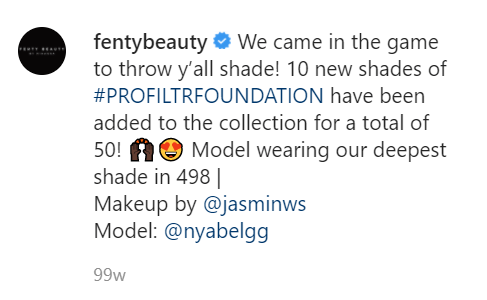
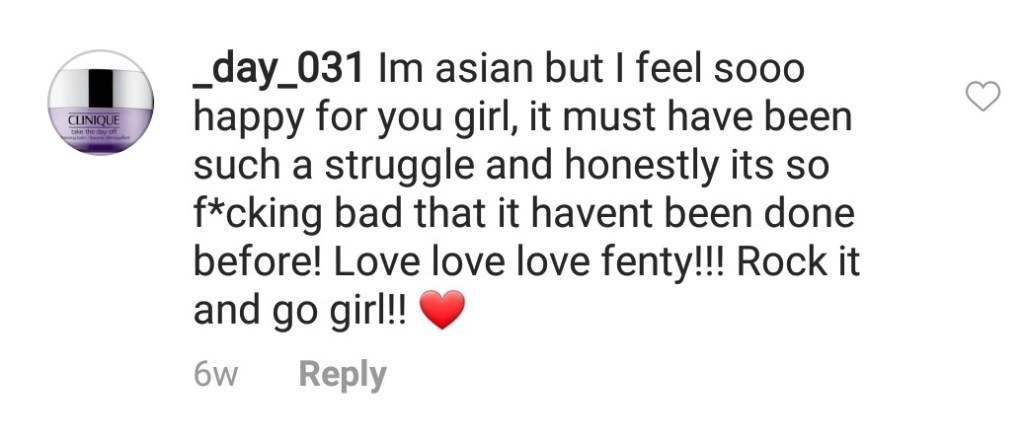

Welcoming the Ethic of Discomfort
An ongoing awareness of racial diversity and inclusion is present throughout Fenty Beauty’s posts. Captions initiate a space for dialogue where users express feedback and share concerns about marginalizing consumer experiences that have reinforced hegemonic representations of race. Concern on both an individual and institutional level is notably important in shaping public opinion.
Discursive Activities in Digital Spaces
Within comment sections, users acknowledge race and privilege to demonstrate allyship, display appreciation toward Fenty Beauty for valuing and promoting diverse and inclusive representation, oppose mainstream beauty standards that are hegemonic; and consequently, call for actionable change across the entire industry. This realizes the extent to which online communities can shape public opinion.
Branding Diversity and Inclusion
Fenty Beauty associates its foundation and concealer products with a sense of belonging. Comments validate several instances where individuality and differences are supported and encouraged.
Within Fenty Beauty captions and user comments, inclusion discourse is more emergent than diversity discourse as the dialogue transcends quantifying differences to demonstrating how individuals come together despite identity markers.
Final Thoughts:
Focusing on the intersection of race and beauty, I was interested in exploring historical and contemporary representations of race in culture and its application to beauty practices and standards. I used Fenty Beauty’s 50 shades as a case study to examine its prospects to shift discourses of race in the beauty industry. I analyzed consumer experiences for racialized individuals to understand the need for diverse and inclusive representation. I recognized social media as a communication tool with the affordance to shift and shape ideologies, norms, and practices. The hope for this research was to make the case for brands and consumers to follow meaningful steps toward diverse and inclusive racial representations in the beauty industry.
 SARAH BOODRAM